Sunday, June 3, 2012

8th Grade Art Books


The 8th grade Art Books is a year long project that hopes to commemorate each individual student's last year of middle school while giving them some freedom to practice problem solving through a more independent practice. Each student's book is different based on their personality and style, but the project also is set up with some guidelines to follow throughout the course of the year.

Altering books
has been an art form since the Victorian period, but not until recently did it have such popularity. Regular old, worn, used or damaged books may be altered into a work of art by changing their original use (to read) and perhaps even their form through various artistic techniques.

At the beginning of the school year, each 8th grader was given an old book to alter during the course of the year. They were able to work on them on certain days set aside just for the books as well as when they got finished early with a project. Some students even chose to take them home from time to time.

Although there was a lot of freedom with this project, I did set up a timeline so that there was a specific set of goals I needed the students to meet for each quarter.
1st quarter- The students added five tabs that broke their book up into sections. The sections are: Family, Friends, School, Sports and Free Space. They had the option of trading out one of the tabs for a second Free Space if they wanted. Some turned their Free Space into a 'Me Space' or a 'Goals' section. One student used his Free Space to show 'Art Styles'.
Each student's tabs could be different. Some students used pieces of colored paper glued to the edge of the page and staggered throughout the book as you might find in an old encyclopedia. Others tried something different by braiding yarn and gluing the loops between two pages.

2nd quarter- This quarter we focused on decorating the first page of each section (Family, Friends, School, Sports, Free Space). You will see some examples of these below.

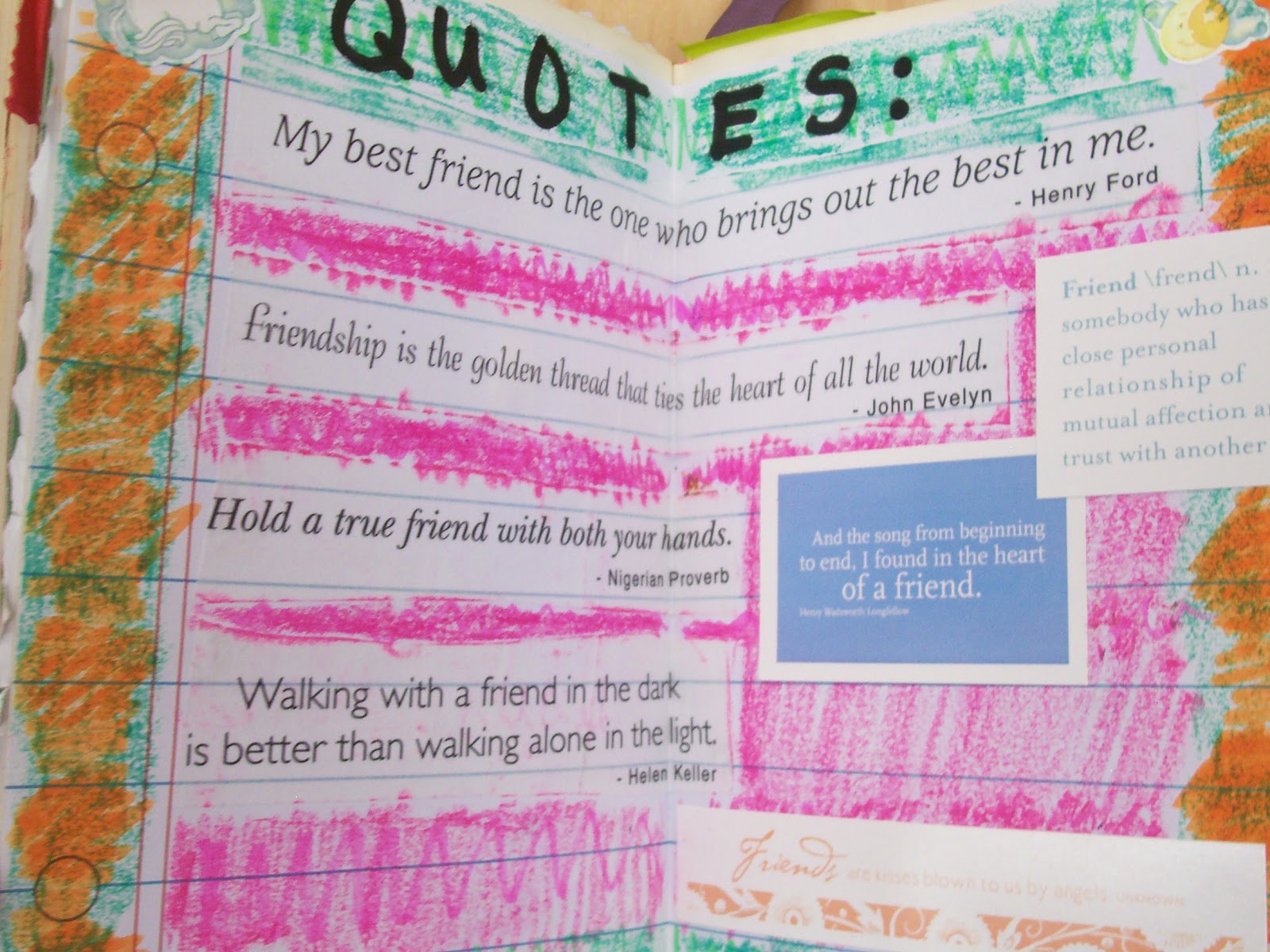
3rd quarter- Third quarter was when we got the pages in our books filled. Each section was to have at least four pages. Pages were decorated with collage, paint, glitter,  stitching, pockets, pop-outs and basically anything that they could creatively think up!

4th quarter- Students added at least one applique (an image created with fabric and in this case, also walpaper samples, construction paper and foam) page and a pop-out or pocket in any section of their choosing.
Last but not least, students added a cover to their book that was to represent themselves.

Below are images of the students' books and some of the pages that are within. Enjoy!




Saturday, June 2, 2012

Drawing Faces-7th

Drawing people is what many seem to think is the most difficult artistic feat. I have consistently heard students say that they would like to build their skills in this. This project can be a scary one to tackle, but if taken step by step, as taught, drawing a person from an image can be a smooth progression from a simple 'map' of a face to a realistic portrait. Students were not required to draw themselves, although some chose to bring in images of themselves and others even used a portrait mirror in class. Most students chose to bring in a picture of a friend, family member or famous person they admire (you might recognize a few Justin Beiber's and Taylor Swift's).
This lesson was a nice segway into our next project, in which the students sculpted busts of famous artists, therefore being able to transfer the applied knowledge of rendering a 2-d image to a 3-dimensional one.


Symphony in Color-6th

Irvington Community Middle School's 6th grade honorable mentions
for the 2012 Symphony in Color Contest


Wednesday, May 16, 2012

Abstract Expressionism-Splatter-Cut-6th


In this project, the sixth graders let their emotions out by applying their new found knowledge of the techniques of such Abstract Expressionists as Jackson Pollock to first create a watercolor splatter painting. But, the project didn't stop there. After their paintings dried, the students used the the principles of design to emphasize (enhance, make pop, draw your attention) to different lines, shapes and patterns they found in their painting by using various materials such as pencils, pens, markers, crayons, oil pastels and even highlighters. The last step in this process pushed the students to let go of how they viewed their original piece by creating a brand new work. They measured and cut their emphasized splatter paintings into one inch squares and finally, rearranged these into new mosaic-like creations.


7th- Eygptian Cartouches