Friday, October 21, 2011

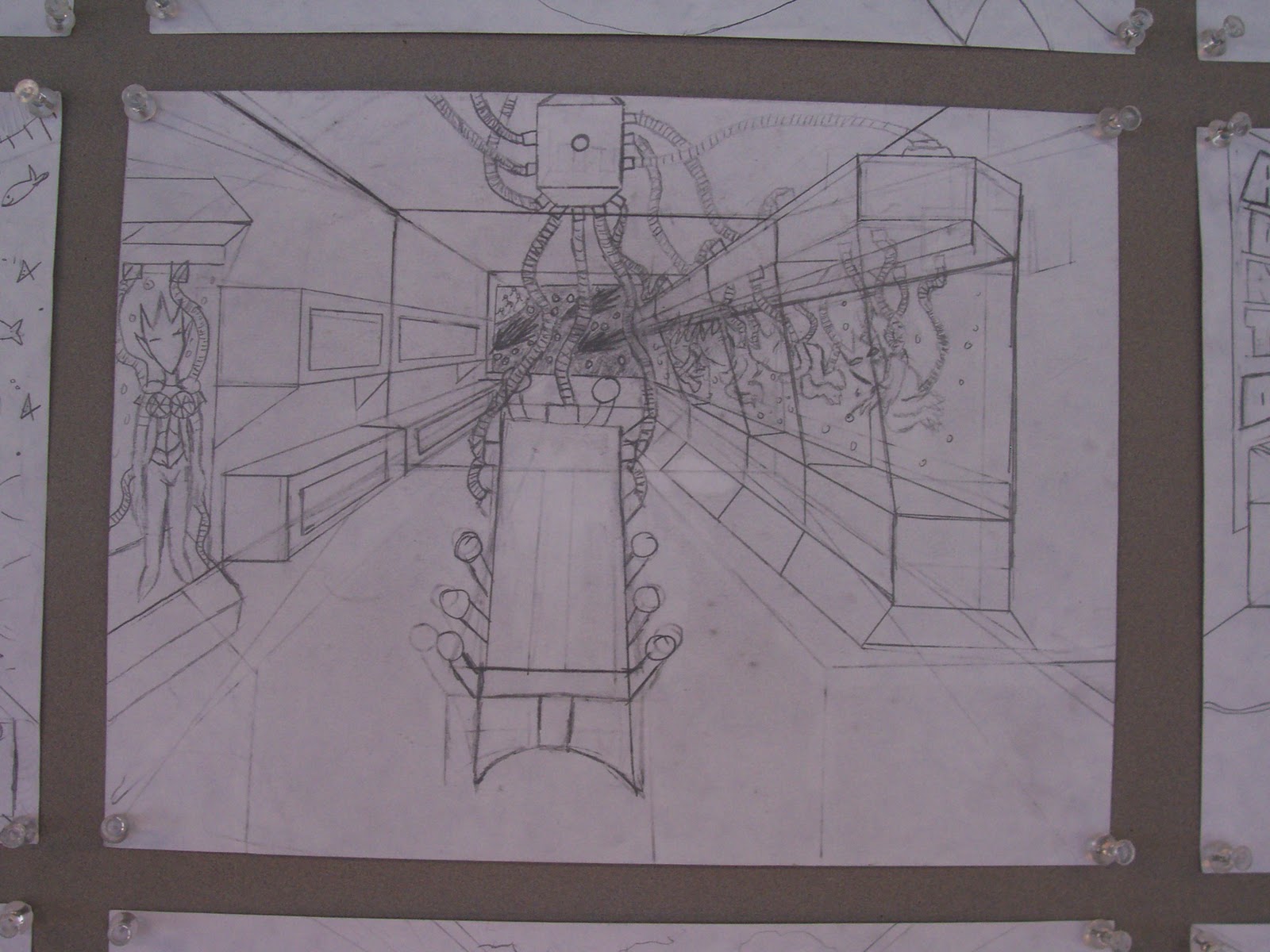
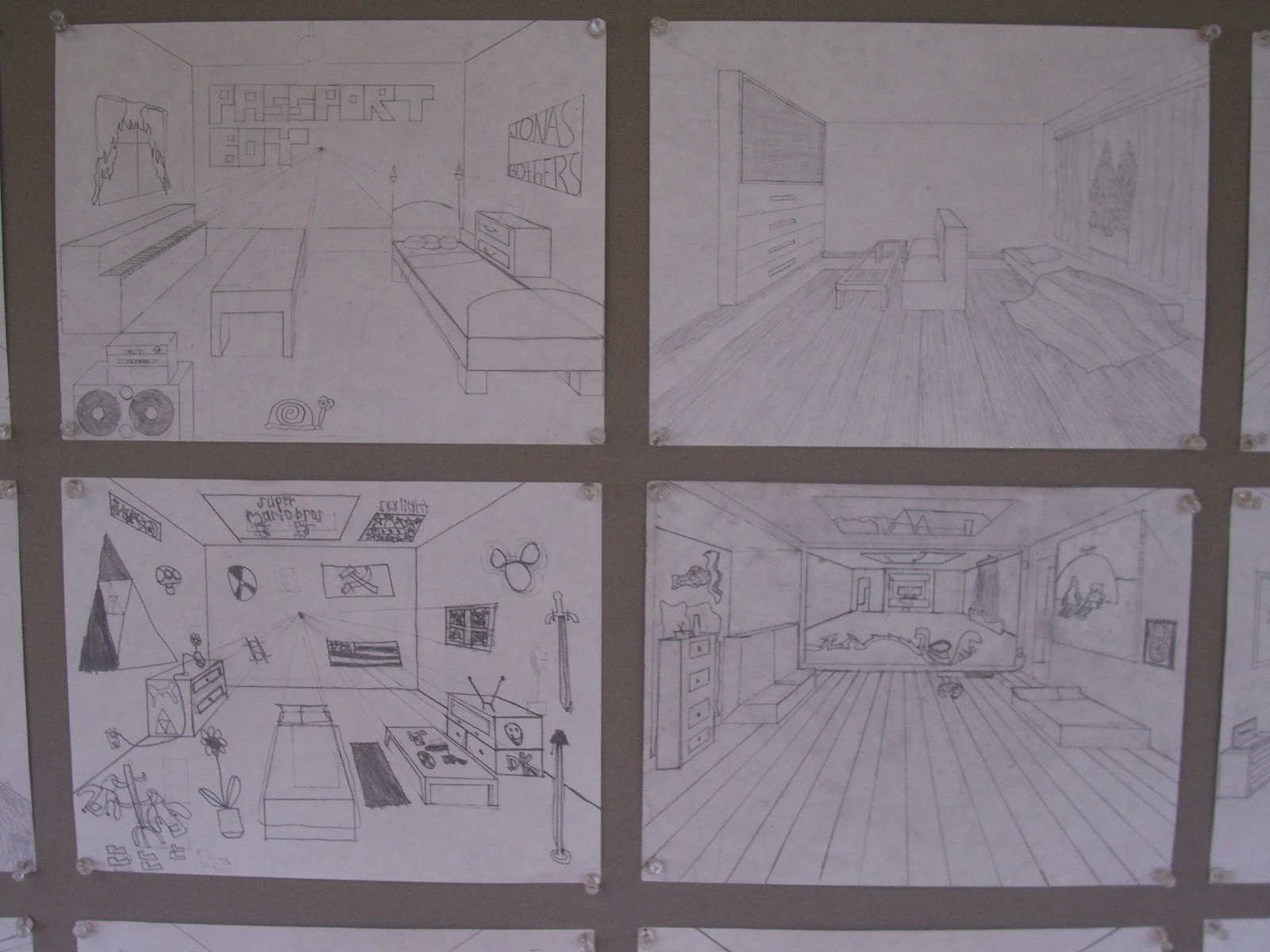
Dream Rooms-One Point Perspective-8th Grade

Most students are excited about the idea to learn out to 'draw 3-D', but when the time comes, perspective drawing can be difficult and confusing. For that reason, I like to introduce the 8th grade's perspective project by asking them, "If you could create a dream room, what would it look like?" We brainstorm some ideas on the board and this gets the students revved up about the project. From there, we discuss the Element of Arts (line, shape, form and space) that are used to create the illusion of 3-dimensions on a 2-dimensional medium (such as paper). Students begin with simple shapes (rectangles) and turn them into forms (rectangular prisms) using the vanishing point. Then, they use the confines of the rectangular prism to create a piece of furniture. I demonstrate some basic forms (beds, dressers, etc) for the whole class and they use these as a guide to construct various pieces for their individual rooms. Finally, they add detail to their rooms such as, pillows and blankets on their beds, books and lamps on their nightstands or whatever works for their 'Dream Room'.






Welcome to the ICMS Art Classroom!

Welcome to the Irvington Community Middle School Art blog! This blog began in 2010 when ICMS began it's first year separate from the elementary school. I wanted to begin this year with a 'virtual tour blog' of  classroom to introduce the 'what's' and 'why's' of the ICMS art room.
One of the first things we did in art class last year was to come up with a list, in each class, of "Why Art Matters!". I combined all the lists from every class as well as used some information from educational research studies to come up with a core list of sixteen reasons for "Why Art Matters!" as you will see below.

1. It's FUN!
2. You can express yourself
3. Art makes life entertaining
4. It's a DE-stressor
5. Art designs and defines our world
6. It can help us remember the past
7. Art promotes kinesthetic learning
8. Art helps us create and construct from our imagination
9. Art aids in discovery and research
10. Schools with art programs do better on standardized tests
11. Art gives us skills like self-criticism and self-correction that readies us for the workforce
12. Art is emotionally satisfying
13. Art can help you have an open mind so that you can see things differently
14. It's humanizing in a technological society
15. Art helps us with our spatial perception
16. It uses higher level thinking skills that can help us in other subjects


One thing we like to do at ICMS is recycle. Recycled materials, such as newspapers, magazines, old books, paper towel rolls and even laundry detergent caps can be used for creating works of art!
If a student gets finished with a project earlier than the rest of the class, they have the option of coloring an Art History coloring sheet of their favorite paintings through time.

Every month, we learn about a different art style or 'ism'. September's art style was 'Art Nouveau'. We look at the images of the art on the overhead, reflecting, analyzing and critically thinking about their meanings. These images also stay up on our 'Ism Board' for the entire month.
 

Students have the opportunity to win a prize from the prize box if they can tell me the name of the Artist of the Month at the end of each month. September's Artist of the Month was Katsushika Hokusai.


Wednesday, October 19, 2011

Radial Designs-6th Grade

For the 6th grader's first project of the year we worked on a project called Radial Designs. Students begin with at least five dots anywhere on their page. Their job is to then 'radiate' from the center of those dots using nice smooth circular lines. No line is allowed to touch another. This usually proves more difficult than it looks. I am very interested in cross-curricular lesson planning by bringing other subjects into the art room. During this project we talk about some math vocabulary especially when it comes to radial symmetries. I connected this math concept to art history by showing works from the 1960's Op Art movement. Much of the art, but not all, produced during this period utilized radial symmetry. I've noticed that students are usually very intrigued by this type of art. Work like M.C. Escher, the Magic Eye series and even Martin Handford of  "Where's Waldo" fame come to mind.
During this project we also studied color theory in depth. The students were able to look at works of art and tell me whether the artist used complimentary, analogous or monochromatic color schemes. We even looked at some fast food chain logos and discovered that many of these logos are designed with colors that make each other pop out (complimentary) to draw your eye. For this project, the six graders chose either a complimentary, analogous or monochromatic color scheme to complete their designs.