Sunday, October 17, 2010

Letters & Numbers: 7th & 8th graders use the style of Robert Indiana to express themselves

Who doesn't know about the famous 'LOVE' statue that we have on the grounds of the Indianapolis Museum of Art? Not only is Robert Indiana's sculpture been replicated by himself (he's actually done several of the statues and paintings), but also by others for art, advertisement and the like. Did you know that Robert Indiana is actually from Indiana? Yes, he changed his name to his location at a time when it was the thing for up and coming artists to do (see Judy Chicago).
One tool I really enjoy using in my classroom to talk about art history, read about current art and see others using art in their lives, is Art Scholastic Magazine. The magazine is great because it showcases artists that kids are usually very interested in. I love it because I'm an art history nut and it gives me a new way to talk about art in the classroom. Also, using these magazines is a great way for me to have students practice non-fiction reading that is pertinent to our lesson. So, when I saw an issue of Art Scholastic that focused on Robert Indiana (a Hoosier born artist!) I was thrilled to share it with the 7th and 8th graders. Much of Indiana's work seems quite simple, but his form of pop art often times has hidden symbols that Indiana called his 'sculptural poems'.
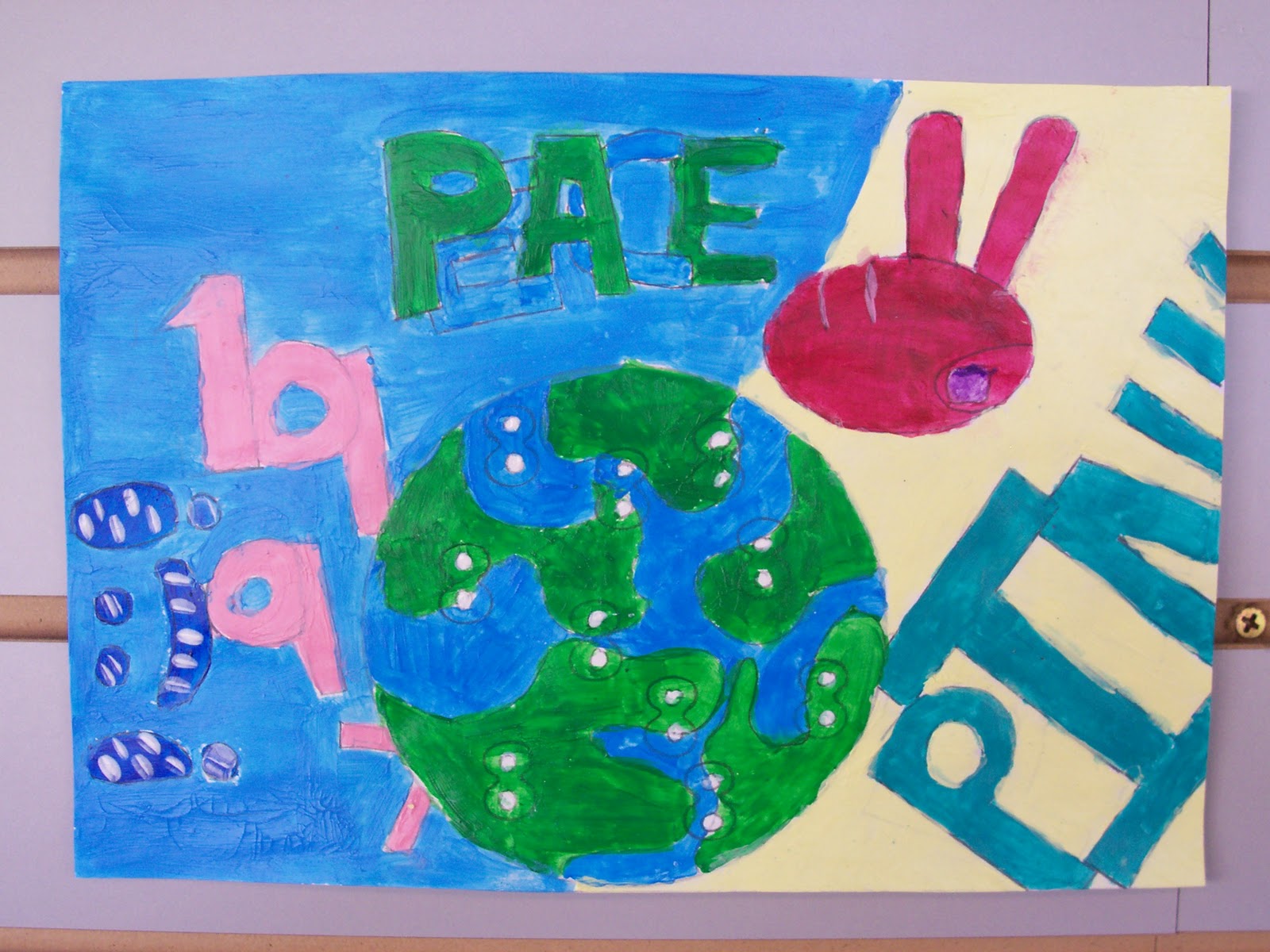
In the style of Robert Indiana's work, the 7th and 8th graders started by listing numbers, words and letters that were important to them in some way. For instance, many students chose to use their birth dates, initials, athletic number, etc. Then, they began to work the numbers, letters and words together uniquely. Finally, they painted their pictures with bold, flat colors. The paint (acrylic) that we used for this project was new to most students, so this was the biggest challenge. Most students at this point had only ever used watercolor or tempera paint. Acrylic can be a more difficult medium because it is not as forgiving as watercolor, is much thicker than tempura and dries super fast. Because of this, many students weren't as happy with how their paintings came out, but I let them know that for their first time use with this type of paint, they all did a pretty outstanding job!




Wednesday, October 6, 2010

Ink Patterns-7th and 8th graders' first project of the year

The 7th and 8th graders' first project of the year focused on patterns with ink. I was fortunate enough to have the unique experience of doing my student teaching at LaGuardia School of Music & Art and Performing Arts, otherwise known as the 'Fame!' school. While there, I taught a graphic design class, a ceramic class and a sculpture class. The graphic design class focused on the basics of laying out designs, not on the computer (yet), but on paper. One of the projects the LaGuardia students worked on was using classic pen and ink to show patterns within shapes. When a shape overlapped another shape, the pattern would change as if two patterns mixed created a whole new pattern. Even though this was a project originally intended for a high school sophomore aged student at a premier art school, I was fully confident that my middle schoolers could pull off this project with success. After showing them the work of the LaGuardia students, some of them began shaking their heads; disbelieving that they could accomplish the same results. I'm happy to say, that the 7th and 8th graders definitely exceeded my expectations on this project! We began by talking about the various shapes that they could start with; organic or geometric. We came up with two simple definitions:
Geometric shapes- an enclosed 2-dimensional shape used in mathematics.
Organic shapes- an enclosed 2-dimensional shape often found in nature.
Then, the students came up with various patterns to place in their shapes and in the negative space around their shapes.
Click on images to enlarge.


Monday, October 4, 2010

Radial Designs-6th grader's first project of the year

I am very interested in cross-curricular lesson planning by bringing other subjects into the art room. During the first quarter, I chose to focus on working math vocabulary and concepts into our art projects. For the six graders' first project, we talked about radial symmetries. I chose to connect this math concept to art history by showing works from the 1960's Op Art movement. Much of the art, but not all, produced during this period utilized radial symmetry. I've noticed that students are usually very intrigued by this type of art. Work like M.C. Escher, the Magic Eye series and even Martin Handford of  "Where's Waldo" fame come to mind.

Click images to enlarge.


Things I would like to share on this blog...

It has taken me a bit of time to get this blog off of the ground. I had these great aspirations of including photos of every single student's work, labeled and cataloged to perfection. Ah, but I didn't think about HOW many students I actually have (the entire school!) and how difficult it would be to take photos of all their work separately and at the same time, get them graded and hung up. When all my students' work was put up on the walls of our school, I began photographing their work. After this I realized that, although I can recognize most of the student's work, I do not have a photographic memory. Therefore, any ideas of putting the student's name with their work on this blog was out of the question (their names were on the back!). But, I really don't feel comfortable putting a child's name up on the internet (unless of course, it was just their initials). So, my intentions now are to get as much work photographed as possible and put up here. Sometimes I will take a photo that includes several works of art from a particular grade. In addition, I will take some photos of individual pieces. I will also be posting some other things on the blog, such as;
  • art websites that may be of interest to you or your student
  • subjects of interest that we've discussed in class
  • "Why Art Matters!" (a list that each of my art classes have contributed to during the first couple weeks of school)
  • explanations of projects and their rationales
  • miscellaneous!